Article
“Unlimited” travel eSIMs: a fair-use comparison worksheet
Compare daily and total full-speed allowances, slowdowns, reset times and hotspot rules before choosing a travel eSIM sold as “unlimited”.
On this page
Choose a travel eSIM sold as “unlimited” by its allowance, speed policy, reset clock and hotspot rules, then check that it covers your stops and dates. The word “unlimited” alone does not tell you how much data is available at the plan’s normal speed or what happens after an allowance is used.
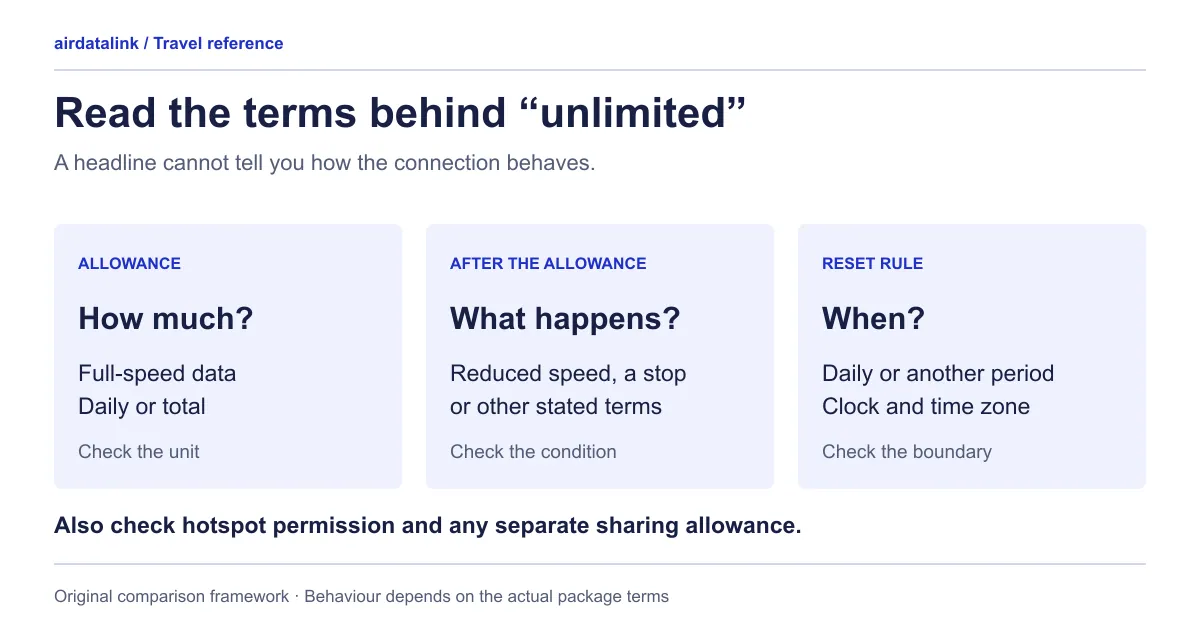
There is no universal rule that every package sold as “unlimited” slows down. Read the selected package’s published conditions. If a condition is absent or unclear, record it as unknown and ask before paying. Where a fair-use amount is stated, airdatalink shows the plan by that full-speed amount and the speed after it, so fill in the worksheet from those plan facts rather than from the word “unlimited”.
Ofcom’s mobile-package guidance advises checking fair-use limits, speed restrictions and allowances abroad. Its guide concerns UK mobile packages; the worksheet below is an original way to apply those comparison questions to a travel purchase.
What advertising rules say about the word
The UK’s advertising regulator publishes guidance on “unlimited” claims for phone and internet services. It says a fair usage policy or traffic management can sit behind an “unlimited” claim only if the limits are moderate and clearly explained in the marketing, and that passing a usage level should not by itself make a customer illegitimate. It adds that wording such as “totally unlimited” implies no limits at all, and that an ad can mislead when the qualification is not clearly shown, as it found in a 2025 ruling.
That guidance governs UK advertising, not every seller, so it is not a rule for travel eSIM listings in general. Its questions still work as a checklist for any listing:
- Is the limit shown next to the headline claim, or only in terms that you have to find?
- Is the speed or usage limit stated, and is it moderate?
- Does the wording avoid “no limits” while a policy applies?
Fair use also appears in official roaming rules. The European Commission’s roaming page says that if your plan includes “unlimited” data, your operator may set a roaming data limit, must tell you in advance and must alert you at 80% of it. Those rules cover a home plan used while travelling in the EU and nearby countries, not a travel eSIM, but they show what a fair-use limit looks like in practice: a defined amount, disclosed in advance.
Translate the label into six answers
Copy the answers from each package’s details into a note. Keep the wording and units, rather than shortening every rule to “unlimited.”
| Field to record | Question that completes the comparison |
|---|---|
| Normal-speed allowance | Is there a daily allowance, one allowance for the whole trip, or no published allowance-triggered reduction? |
| What happens next | Does data continue at a stated reduced speed, stop, incur a charge, or follow another policy? |
| Reset rule | Does the allowance renew? At what time, in which time zone, or after what rolling interval? |
| Hotspot | Is sharing permitted, and does it use the phone’s allowance or a separate limit? |
| Validity | What starts the clock, when does it end, and can it extend across your travel dates? |
| Coverage | Are all intended countries currently usable under this exact package? |
A high-speed allowance is the amount available before a stated policy change. A total allowance is the amount available across a stated period. Neither is a promised download speed: separate the allowance rule from any performance claims.
“After 2 GB, reduced speed applies” is incomplete without the period. Two gigabytes per day and two gigabytes for the entire trip lead to different choices. Likewise, “resets daily” needs a clock. Do not assume midnight follows your phone as you cross borders.
Work through fictional examples
Every value in this table is invented for explanation. These are not airdatalink catalogue products, prices, measurements or recommendations. The names describe the example rules only.
| Condition | Daily continuing plan | Trip continuing plan | Fixed-data plan | Plan without an allowance-triggered reduction |
|---|---|---|---|---|
| Normal-speed data | 2 GB each day | 20 GB for the trip | 20 GB for the trip | No allowance threshold in this example |
| After allowance | Continues at 256 kbps | Continues at 512 kbps | Stops until an eligible top-up | No change triggered by data volume in this example |
| Reset | Midnight in Singapore time | No daily reset | No daily reset | Not applicable |
| Hotspot | Shares the daily 2 GB | Separate 5 GB trip limit | Shares the 20 GB | Allowed; no separate allowance in this example |
| Validity | Seven days from first connection | Seven days from first connection | Seven days from first connection | Seven days from first connection |
The fixed-data example provides a useful control: continuing data and a hard cutoff are different outcomes. The final column also shows why “unlimited” should not automatically be translated into “throttled after a cap.” Actual packages may publish other restrictions; none can be inferred from this fictional table.
For a seven-day trip, the daily example offers seven separate 2 GB allowances. That does not create a bank of 14 GB to spend whenever you like. In this example there is no carry-over, so a quiet day cannot fund a larger upload tomorrow.
Suppose you need to upload an invented 3 GB folder on one afternoon. The daily example crosses its normal-speed allowance even if yesterday was quiet. The trip example has enough normal-speed data if its remaining trip allowance exceeds 3 GB, but its separate hotspot limit also matters when uploading from a laptop.
Make the clock visible
Write the reset time beside your itinerary in both the package’s stated zone and your local zone. For the fictional Singapore-midnight rule, a traveller in Bangkok would mark 23:00 Bangkok time. This conversion applies to those two time zones; it is not an airdatalink reset policy.
Ask whether unused daily data carries over and whether a “day” means a calendar day or a rolling 24 hours. Also distinguish the allowance reset from the plan’s final expiry. A renewed daily allowance does not extend an expiring package.
What a reduced speed can and cannot do
A plan that continues at a reduced speed is not the same as one that stops, but a slow connection is not a free pass. Zoom’s bandwidth page lists 60–80 kbps as recommended for audio-only meeting calls and 600 kbps for high-quality one-to-one video (up and down). Compare the reduced speed on a plan page with the figure your busiest task lists. A reduced speed far below an app’s listed figure is a warning for that app, though not a test, because apps differ and the listed figures are recommendations. In the fictional table above, 256 kbps sits above Zoom’s audio-only figure and below its video figure, and 512 kbps is still below it; that is an illustration of the comparison, not a statement about any real plan. Schedule the tasks that list higher figures, such as video calls, while full-speed data remains.
To estimate how long the full-speed amount will last, use the data-budget worksheet.
Choose for your busiest task
Identify the one activity you cannot postpone: a laptop upload, a live meeting, navigation during a transfer, or sharing with another traveller. Compare the conditions for that task before comparing total price.
A published reduced-speed figure is useful evidence, but it does not guarantee that a particular app, call or upload will work well. For a time-sensitive task, arrange a backup connection rather than treating a large allowance as a performance test.
Save the selected package’s conditions with your receipt. Before departure, confirm its installation and validity instructions through the installation guide. During the trip, use Check eSIM usage and note the reading’s update time. Supplier readings can lag behind real use, so treat a reading as a recent snapshot, not a live meter. A clear record of the rule is more useful than the label when deciding whether to wait for a reset, change your usage or seek support.
When you are ready to compare real plans, browse travel eSIM plans by destination and fill in the six fields from each plan page.
Common questions
Is a travel eSIM sold as “unlimited” really without limits?
You cannot tell from the word. Read the plan’s full-speed amount, what happens after it, the reset rule and the hotspot rules. Where a fair-use amount is stated, the plan is named by that full-speed amount plus the slowdown, so the plan page is the thing to compare.
What is a fair use policy on an eSIM?
It is the rule that sets how much data you get at normal speed, and what happens after it: a slower speed, a stop, or another stated policy. The UK advertising regulator says such limits should be moderate and clearly explained alongside any “unlimited” claim; a good plan page does the same.
What speed do I get after my daily data runs out?
The plan page states the reduced speed, so copy it into your worksheet. Then compare it with what your busiest task needs: Zoom, for example, lists 60–80 kbps for audio-only calls and 600 kbps for one-to-one video.
Does unused daily data roll over?
Do not assume it does. In the fictional example above there is no carry-over, so a quiet day cannot fund a heavy one. Check the plan’s own reset and carry-over rule, and write down when the reset happens in your own time zone.
Can I use a hotspot on a fair-use plan?
That depends on the plan. Check whether sharing is allowed and whether it shares the same allowance; the hotspot guide covers how to check permission and set sharing up.
Sources
- Ofcom: choosing the right mobile packagechecked 7 October 2026
- Advertising Standards Authority: internet unlimited claimschecked 30 October 2026
- European Commission: roaming in the EUchecked 30 October 2026
- Zoom Support: bandwidth requirements for Zoom Meetingschecked 30 October 2026
Related guides
Browse destinationsBrowse compatible phonesRead the installation guide