Guide
eSIM for India: how visitors get one, and what needs KYC
Does India have eSIM? Yes, but Indian operators need KYC. See what visitors can use instead and what to check before a trip to India.
On this page
Yes, India has eSIM, but the eSIMs that Indian operators such as Jio and Airtel sell are local connections that need identity checks (KYC). Airtel’s own eSIM page tells a new customer to visit a store with ID proof, and it does not mention foreign visitors. If you are visiting India, a travel eSIM is a different product: a data plan you buy online before you go. See current India eSIM plans for options. If you live in India and want an Indian number on an eSIM, ask your operator; this guide is for visitors.
Local eSIM or travel eSIM: what is the difference?
| Local eSIM from an Indian operator | Travel eSIM for visitors | |
|---|---|---|
| What it is | A connection in your name on that operator’s network, with an Indian number | A data plan for the length of your trip |
| How you get it | Airtel says a new eSIM connection means visiting a store with ID proof. Jio’s charter says service is activated after verification of the application form, photo and proof of identity and address | Buy online and install over Wi-Fi |
| Verification | KYC under Department of Telecommunications (DoT) rules | The plan page shows whether any ID step applies |
| Suits | Residents and long stays | Short visits where mobile data is enough |
Sources: Airtel and Jio’s consumer charter.
What a visitor needs for a local SIM
Rules for local connections come from DoT and the operators, and foreign visitors are a recognised category. DoT’s list of acceptable identity and address documents includes the passport (DoT document list), and its digital KYC instructions say the additional safeguards for outstation and foreign customers still apply (DoT instructions).
Jio’s charter adds that a foreign tourist’s service is valid for at most three months or until the visa ends, whichever is earlier, and that the operator may seek verification that includes a local reference for foreign customers.
DoT publishes a separate document list for the Jammu and Kashmir service area and another for Assam and the North East, and the passport appears on all three lists. The operator pages we checked do not describe an eSIM route for visitors, so if you want a local eSIM, ask at an operator store which documents it will accept and whether it can issue an eSIM to a visitor.
Check your phone supports eSIM
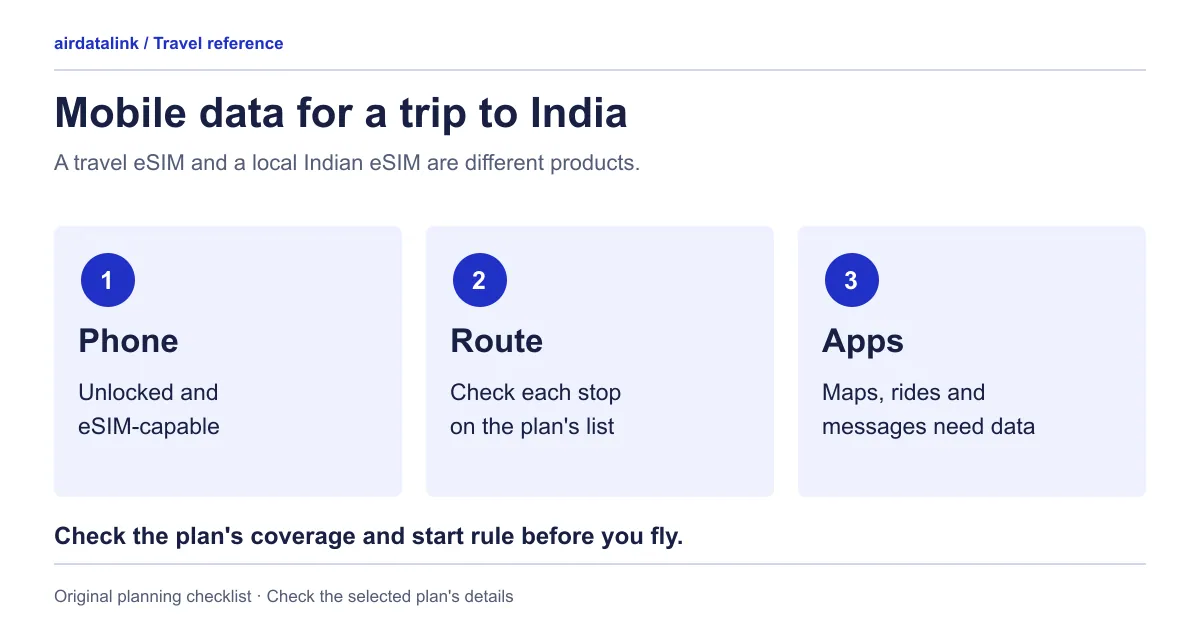
You need an eSIM-capable phone that is not locked to its original network. Apple lists the iPhone XS, XS Max and XR and later as eSIM-capable, and says a plan from a different network needs an iPhone that its provider has unlocked (Apple’s dual SIM guide). Check a specific model on our eSIM compatible phones page before you buy.
Choose a travel eSIM for your route
For a trip only in India, start with the India eSIM page, which lists the data, days, start rule and whether you can top up. If your trip also takes in a neighbouring country, compare South Asia eSIM plans and check that every country on your route is covered.
Choose data from how you use your phone: a total allowance suits uneven days, while daily data suits steady use. How much data a travel eSIM needs turns your habits into a number.
India is large, and mobile coverage differs between big cities and remote or mountain areas, and from state to state. For long train, road or trekking days, download offline maps first. Google notes that offline navigation only works when the whole route is inside the downloaded area (Google Maps Help).
Install and start rules
Plans differ in what starts the clock: some begin when you install the eSIM, others when it first connects. Follow the start rule on your plan. Install over Wi-Fi using your delivery email or the eSIM installation guide, and label the line so you recognise it. On arrival, choose the travel line for mobile data; Apple and Google both let one SIM be the data line at a time (Google Pixel’s dual SIM help). Check your home line’s roaming setting separately.
Apps and services that need data or a number
A data connection covers maps, messaging and ride apps. Two services need more thought.
- IRCTC train tickets. IRCTC’s foreign user guide says registration asks for a mobile number with a non-Indian country code and sends a verification code to it. A data-only plan will not receive that text, so register before you travel, using a number that can receive SMS. The guide is undated, so check the current sign-up flow. Data-only eSIMs, calls, SMS and WhatsApp explains how to keep your home number for texts.
- Payments. Many shops and drivers take phone payments linked to Indian bank accounts. Carry a card and some cash, and ask your card provider about using it in India.
Common questions
Does India have eSIM?
Yes. Indian operators such as Jio and Airtel issue eSIMs, but a new local connection needs KYC, and Airtel’s page sends new customers to a store with ID proof. Visitors can use a travel eSIM instead, bought online before the trip.
Can a tourist buy an Indian SIM or eSIM?
Passport is among the documents DoT accepts. Jio’s charter says a tourist’s service lasts at most three months or until the visa ends, and the operator may ask for a local reference. No operator page we read describes an eSIM for visitors, so ask in a store.
Do I need KYC for a travel eSIM?
A local operator eSIM needs KYC. For a travel eSIM, the plan page shows whether any ID step applies before you pay.
Will a travel eSIM work in every state?
Coverage varies by area and network, and remote or mountain areas can be patchy. Download offline maps and save bookings before long journeys.
Sources
- Reliance Jio: Telecom Consumer Charter 2025checked 30 October 2026
- Department of Telecommunications: Acceptable documents for proof of identity and addresschecked 30 October 2026
- Department of Telecommunications: Instructions for alternate digital KYC process (3 April 2019)checked 30 October 2026
- Airtel: eSIM cardchecked 30 October 2026
- Jio: eSIM in Indiachecked 30 October 2026
- IRCTC: Foreign user registration guidechecked 30 October 2026
- Apple Support: Using Dual SIM with an eSIMchecked 30 October 2026
- Google Pixel Help: How to use dual SIMs on your Google Pixel phonechecked 30 October 2026
- Google Maps Help: Download areas and navigate offlinechecked 30 October 2026
Plans for your trip

Related guides
Browse destinationsBrowse compatible phonesRead the installation guide