Article
One eSIM for Japan, South Korea and China: what to check
Japan Korea eSIM or China too? Compare one regional plan with a plan per stop: coverage list, IP location, start rule and daily or total data.
On this page
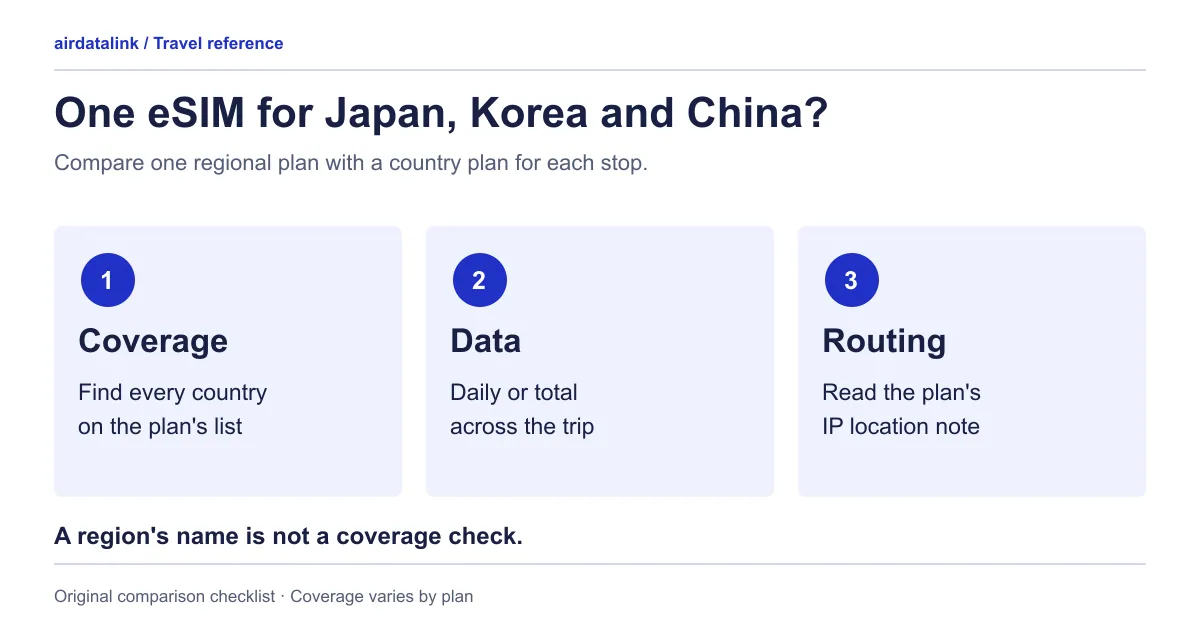
For Japan, South Korea and China on one trip, a single regional eSIM is the simplest setup if its coverage list names all three countries. A plan for each stop is safer if one leg has its own needs, such as a Japanese IP address or a big data week. Don’t choose from the plan’s name or country count. Check four things on each plan page before buying: the countries listed, where your data reaches the internet (the IP location note), what starts the plan’s days, and whether data is daily or one total. The East Asia region page lists the regional plans to start from.
Which plans cover which stops
At the time of writing (30 October 2026), the East Asia region page lists the plans below. Open each plan’s coverage list rather than relying on this table.
| Option | What it covers | What to confirm |
|---|---|---|
| Asia 15 eSIM | Six of the seven East Asia countries | Japan, South Korea and China all appear in its coverage list |
| Asia 28 eSIM | Six of the seven East Asia countries | The same three countries appear in its coverage list |
| China, Hong Kong, Macao & Taiwan (Greater China+) eSIM | Four: China, Hong Kong, Macao and Taiwan | It has no Japan or South Korea leg |
| A plan per stop | Japan, South Korea and China each have their own plans | Each plan’s own start rule, data and extras |
Six of seven is not the same as your three. If a plan’s list is missing one of your stops, it can’t be your single eSIM, however many countries its name promises.
Where your data comes out matters
Each plan page shows an IP location note: the country where your data reaches the public internet. It can differ from the country you are standing in. It doesn’t change your phone’s GPS location or add mobile coverage there; it changes what websites and apps see. The destination pages describe the country plans like this:
- Japan. The Japan eSIM (IIJ-Docomo) gives you a Japanese IP address, so Japanese apps and sites see a local user. The Japan Premium eSIM connects through Singapore.
- South Korea. The South Korea eSIM Premium connects through Singapore, and the South Korea eSIM through Hong Kong or Singapore, so websites see that location rather than a Korean one.
- China. Both China eSIMs send data out through Hong Kong or Singapore, from outside mainland China. What that does and doesn’t mean for WhatsApp, Google and maps is in our China eSIM guide.
If a Japanese ticket site or streaming service needs a Japan IP, that points to the Japan plan for that leg. A regional plan states its own IP location, which can list more than one country. Read that note and don’t assume it matches the country plans above.
Start rules can differ on one trip
The destination pages say the Japan eSIM (IIJ-Docomo) starts when you install it, while the Japan Premium eSIM, both South Korea eSIMs and both China eSIMs start when they first connect to a network in that country. So three country plans don’t share one rule, and “install everything at home” isn’t safe advice for all of them. Follow the start rule on each plan’s page, including the regional plan’s. Our guide to when a travel eSIM starts shows how to put install date, first use and expiry on one timeline.
Daily or total data across three countries
A daily plan gives you a fresh allowance each day. Reset times differ: the Japan page says IIJ-Docomo daily plans reset at midnight Japan time, and the destination pages describe other daily plans as resetting 24 hours after the plan started. A heavy day in Tokyo can’t borrow from a light day in Seoul. When a daily allowance is used up, speed drops until the next day’s data arrives, and the plan page states the slower speed.
A plan with one total allowance suits uneven days, such as a travel day with uploads and a quiet day with maps only. Once it’s spent, it’s spent. Country plans each carry their own allowance, so what’s left in Japan doesn’t carry to Korea. A regional plan’s allowance and days usually apply across all its countries; its plan page states the exact terms. To size it, use our travel eSIM data budget worksheet.
Hotspot, calls and top-ups: read each plan
Hotspot, calls and SMS, and top-ups vary by plan, so one plan’s facts don’t carry to the next. The Japan page, for example, says IIJ-Docomo plans can’t be topped up while Premium daily plans can, so choose enough days and data when you buy. Check the plan page for anything you rely on, and see the top-up page for how it works where it’s offered.
One eSIM or several: a quick decision table
| Your trip looks like | Lean towards |
|---|---|
| Short stops in each country, one install and one set of settings | A regional plan whose coverage list includes all three stops |
| A Japanese IP matters, or most of your days are in Japan | The Japan plan for that leg, then choose for the others |
| China is a brief stop and you want its plan-page facts | A China plan for that leg |
| The trip adds Hong Kong, Macao or Taiwan but not Japan or Korea | The Greater China+ eSIM |
| You can’t find one plan listing all three | The trip planner, which compares packages for your stops and days |
Compare real checkout totals for both setups, including any extra purchase that closes a gap in days or services. Our regional or country eSIM worksheet walks through that comparison for another trip.
Switching between eSIMs on your phone
Apple says supported iPhones can have two eSIMs active at once and lets you choose which line carries mobile data in Settings > Cellular > Cellular Data (Apple Dual SIM guide). Google says a Pixel 7 or later can use two eSIM profiles if your carrier allows it, and only one SIM can be the default for data (Pixel Help).
Check your model on the eSIM compatible phones page and follow the plan’s own steps in our eSIM installation guide.
Prepare each arrival
For Tokyo, the Narita and Haneda arrival guide covers airport trains and an offline arrival note.
For Seoul, the Incheon and Gimpo arrival guide does the same. Seoul’s city government lists NAVER Map and KakaoMap for directions, so try one with your hotel before you fly.
Common questions
Is there one eSIM for Korea and Japan?
Possibly. The Asia 15 and Asia 28 eSIMs each cover six of the seven East Asia countries; open their coverage lists and check that both Japan and South Korea appear. If they do, one install covers both legs. If you’d rather have each country’s own network and IP location, use a Japan plan and a South Korea plan.
Is there an eSIM for China and Korea, or China and Japan?
The Greater China+ eSIM covers China, Hong Kong, Macao and Taiwan, so it isn’t a Korea or Japan plan. For China with Korea or Japan, look for a regional plan whose coverage list includes both, or pair a China plan with a Korea or Japan plan.
Will WhatsApp and Google work in China on a regional plan?
Our China page makes that statement only for the two China eSIMs, which send data out through Hong Kong or Singapore. For a regional plan, read its IP location note. The China page’s wording doesn’t automatically apply to it.
Do I need a separate eSIM for each country?
Not if one regional plan lists all three. With country plans you install one per stop, switch the data line when you move on, and each plan’s start rule decides when its days begin.
Sources
- Apple Support: Using Dual SIM with an eSIMchecked 30 October 2026
- Apple Support: Use eSIM while traveling internationally with your iPhonechecked 30 October 2026
- Google Pixel Help: How to use dual SIMs on your Google Pixel phonechecked 30 October 2026
- Seoul Metropolitan Government: Communication, internet and useful mobile appschecked 30 October 2026
Plans for your trip



Related guides
Browse destinationsBrowse compatible phonesRead the installation guide